BLEACHERS BREW EST. MAY 2006

Someone asked me how my blog and newspaper column came to be titled "Bleachers Brew". It's like this, it's an amalgam of sorts of two things: The bleachers area in the stadium/arena where I used to sit when I would watch baseball, football, and basketball games and Miles Davis' great jazz album Bitches Brew. That's how it got culled together. I originally planned on calling it "The View from the Big Chair" that is a nod to Tears For Fear's second album, Songs from the Big Chair. So there.

Thursday, May 6, 2010

Another impressive win by the Ateneo Blue Eagles


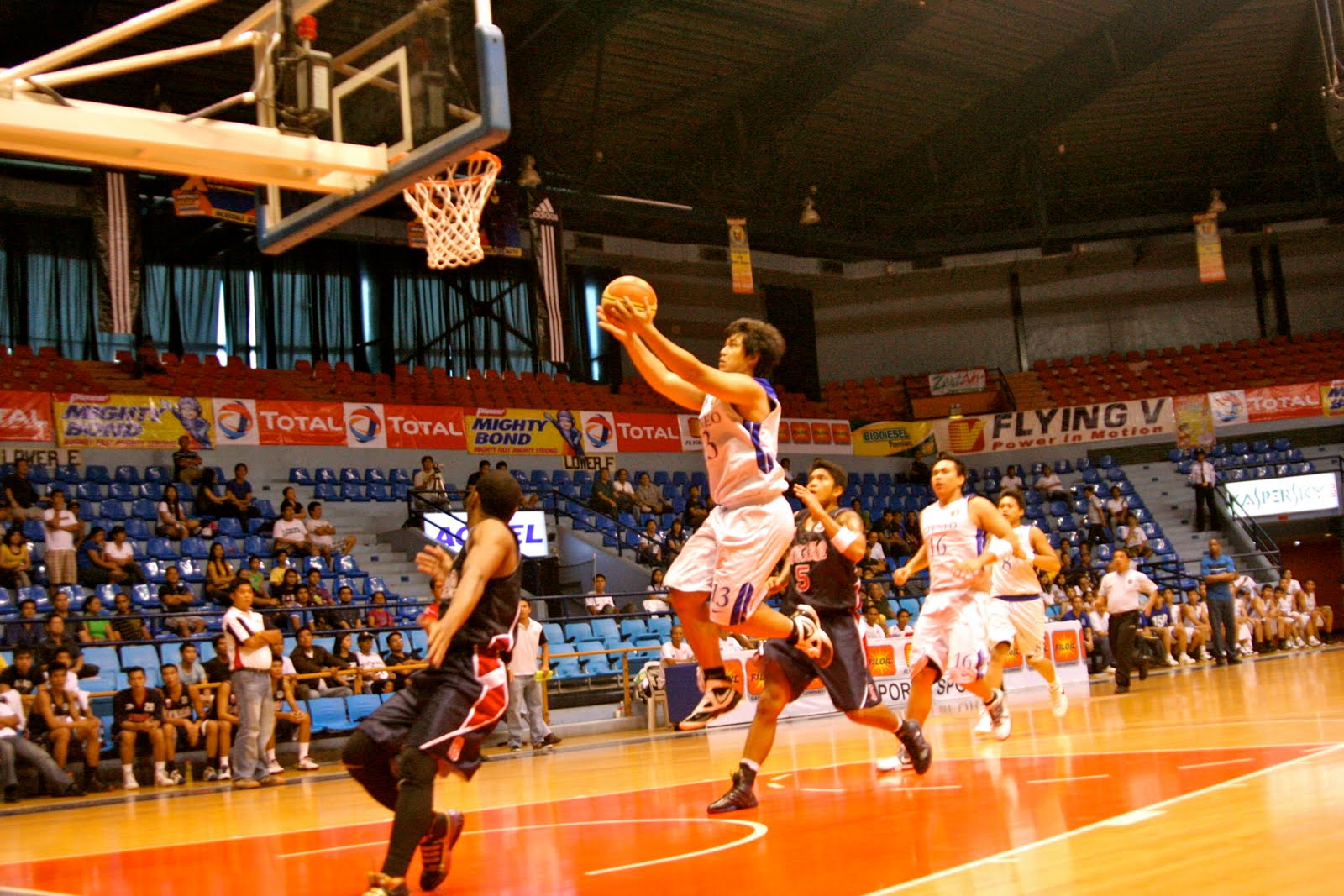
Chito Loyzaga lives! Ryan Buenafe defies gravity to score on the break.

As much as I thought that Ateneo's offense was a sight to behold, the interior defense could still use some work. But allow me to gush about that offense. Doesn't that remind you of the way San Miguel Beer used to run up and down the court with that ball whipping around to the open man? In case you weren't around then well now you know.

I wasn't able to watch the match against UPHDS but I caught the past two versus UP and Letran. In a pair of matches where I expected players to bump and thump, instead it was the opponents who got thumped.

Norman Black has become the finest college coach in the land. Since 2006, his teams have been a joy to watch. Even the ugly games that they take via game winners? How many teams have had more comeback victories than the Blue Eagles? If the New York Yankees as the masters of the comeback win in baseball then in Philippine college hoops, then tip that hat to the Blue Eagles.

Even in that loss against La Salle, the team was just beginning to get its bearings. And as in the UP game, players were taking shots in the flow of the game. Nothing was forced. They always made the extra pass that led to a basket. And they left UP and Letran playing one-on-one.

In the first quarter, my friend Ken said the team would score a hundred. And they did. We were even hoping they'd hit 120. The downside of that offensive display was -- they gave up 90 points. The team in recent years would surrender 60-something points. Even as JP Erram is getting more comfortable, they still had trouble with Jam Cortes and Jon Belorio; the wide-body and active sort. Either we fouled them or they scored on us.

The plus here for Letran is that JP Belencion showed that he is ready to step into the gunner's role vacated by Rey Gutilban. That was some great shooting.

And Letran which prides itself in its defense was forced to play catch up. They couldn't really get physical because they couldn't catch Ateneo on the break.

Despite the high score, this was an impressive 114-90 win. But this team will be in shape in a few weeks' time when they go two-a-day in their their stay at Las Vegas and Los Angeles.


Ateneo 114 - Salamat 21, Salva 19, Monfort 18, Long 11, Escueta 10, Buenafe 10, Austria 6, Tiongson 5, De la Cruz 4, Erram 4, Chua 2, Golla 2, De Chavez 2, Burke 0, Gonzaga 0

Letran 90 - K. Alas 20, Belencion 18, Cortes 14, Dysam 12, Belorio 11, Espiritu 5, J. Alas 4, Almazan 3, Taplah 2, Pantin 1

Wednesday, May 5, 2010

Ateneo Blue Eagles undergo Gatorade Sweat Test


Ateneo Blue Eagles undergo Gatorade Sweat Test

Last April 2010, scientists from the Gatorade Sports Science Institute (GSSI) conducted a sweat analysis test on the back-to-back UAAP Men’s Basketball Champion the Ateneo de Manila Blue Eagles at the Moro Lorenzo Sports Center.

The sweat tests are used to help GSSI scientists determine if the Blue eagles are adequately replacing the fluids and electrolytes like sodium and potassium they lose through sweat during training.

Based on the results, GSSI scientists will provide hydration programs that will help prevent cramping. Some of the Blue Eagles such as skipper Eric Salamat in particular, is prone to cramping. With Salamat a vital piece in Ateneo’s defense of the coveted collegiate basketball crown, it is hoped that the program will help optimize his performance come Season 73 that kicks off this July 2010.

Gatorade’s assessment test shows how well a player replaces the fluids he loses through sweat during training by measuring a player’s weight change pre- and post-exercise to calculate a player’s fluid lost vs. fluid replaced. The test can show how rapidly dehydration occurs.

This is the third-year that GSSI has been conducting sweat tests on the team. It is hoped that they will be able to conduct these tests on a regular basis during the season to better be able to track the team’s progress with regards to the hydration program.

Established in 1988, The Gatorade Sports Science Institute, headquartered in Barrington, Illinois (USA), is a research and educational facility dedicated to enhancing the performance and well being of athletes. Every year, GSSI educates more than 100,000 members who are primarily sports and health professionals on the latest sports science information through direct communications, educational programs and tools, conferences and professional meetings in the U.S. and around the world. For more information about sports nutrition and exercise science, visit the Gatorade Sports Science Institute Web site at www.gssiweb.com.


I'm going back to Playstation


Stupid fans 0 Taser Guy 1
Just because you bought a ticket to the game it doesn't mean you have the right to make an ass out of yourself. Seventeen-year old Steve Consalvi called up his father to ask permission to run on the field of the Citizens Bank Ballpark during a Philadelphia Phillies game against the St. Louis Cardinals. Against his father's wishes, he scooted off during the 8th inning and got tasered for his trouble. Well, Philadelphia continues to make a name for itself for having some really stupid and obnoxious fans. C'mon! Isn't it too much? Nah. Some people never learn. (photo taken from Big League Stew)

Here's a video of another dumbass fan being tasered in Oakland.

Tuesday, May 4, 2010

Chicago Bull****

There have been 20 head coaches for the Chicago Bulls since their maiden year in 1966. Three have won NBA Coach of the Year Honors in Johnny “Red” Kerr, Dick Motta, and Phil Jackson. Two are in the Hall of Fame (Jackson and Jerry Sloan). Of the 20, only Motta and Jackson have won Division Championships with PJ winning six Larry O’Brien trophies.

When the Bulls were the toast of pro basketball, their leadership was worried that the team was going the way of the Larry Bird’s Celtics – grow old with the pieces past their prime and nigh untradeable.

So they broke up the dynasty before it was even dead. In a moment of hubris, Jerry Reinsdorf and Jerry Krause wanted to recreate their success sans their major players thinking their financial flexibility would draw top free agents to their team.

As it is, they went nowhere. Twelve years after the Last Dance, the Bulls are still rebuilding.

I recall when the Bulls let go of Doug Collins for Jackson, it was clear that the former Philadelphia 76er had taken them as far they could go – in the Eastern Semis.

Interestingly, after all their success with Jackson, they ran him out of town and into the welcome arms of the Los Angeles Lakers where he’s won four titles in six tries.

In Jax’s wake, there have been eight coaches – Tim Floyd, Bill Berry, Bill Cartwright, Pete Myers, Scott Skiles, Jim Boylan, and now, the latest casualty, Vinny del Negro. So none of this madness makes sense.

Sure Vinny might not have come in with sterling credentials but you have to give him credit – he got the Bulls to the play-offs twice. He finished his two years at an even .500 (82-82). His problems with letting Joakim Noah play reminded me of the fate of Stan Albeck who had to watch Jordan’s minutes after he came back from a foot injury. He earned the ire of MJ but was only following orders.

But what gives? The three coaches who have guided the Bulls to the playoffs in the Modern Era have been given a modern-day running by the Bulls front office!

Scott Skiles, who began the Bulls’ revival and also led them to the playoffs including a memorable sweep of defending champion Miami in 2007.

This next part, I took from wikipedia:

“Skiles came to the Chicago Bulls as head coach where he focused on improving the young Bulls' defense and developing greater consistency in a talented but underachieving team. In the first full year under his direction, Chicago limited its opposition to an NBA-best .422 field goal percentage and held their opponents to a franchise record and NBA season-high 26 straight games below 100 points. Scott was named NBA Eastern Conference Coach of the Month for January 2005 after guiding the Bulls to an NBA best 13-3 mark in that month.

In 2006, Skiles led his Bulls to a 41-41 record (earning a 7th seed in the playoffs) and faced the Miami Heat (the 2nd seed) in the first round of the playoffs, losing in six games. However, in 2007, Skiles led the Bulls to a 49-33 record, and again faced the Heat, this time sweeping them in four games. However, the Bulls went on to lose the first three games of their second-round series against the top-seeded Detroit Pistons, losing Game 3 at the United Center after holding a double-digit lead for much of the game. After winning two consecutive games to stave off elimination, the Pistons finally finished off Skiles and the Bulls in six games.

Scott Skiles was fired from the Bulls on December 24, 2007. At the time, the Bulls were last in the Central Division with a 9-16 record after having high expectations heading into the season. "This was a difficult decision to make, but one that was necessary at this time," Bulls general manager John Paxson said in a press release.”

It’s been hard to follow this team as they have constantly traded away players who have flourished elsewhere – Tyson Chandler, Thabo Sefolosha, Elton Brand, and Ron Artest are but a few. There is no longer pride in playing for this team. And this from a franchise that had a player who influenced everyone from Kobe Bryant to Manu Ginobili to LeBron James to Dwyane Wade.

When people ask me why I still root for the Bulls when Michael Jordan has long been gone, I answer – “It’s because I’m a fan of the team as well.”

As for this team, I have no clue what they are trying to do. Sometimes I wish teams could jettison stupid owners and executives as well.

What's in the works

My Monday column on K was a long time coming. That was supposed to get done in Season 71 but I never got around to it. The past Season 72, I missed the track events as I was abroad. So I had no excuse not to get it done this time. My other regret when it comes to track was not doing that piece on Marla Santos, Mica Sibayan, and Maita Mendoza. I lost my notes during Ondoy. Yep, some excuse.

This coming college basketball season, you'll read stuff on CSB, JRU, and CSLJ. As for the UAAP, there's UE, UP, NU, and Adamson.

For the fourth issue of Rebound, here's my stuff:
- my column, From the Parking Lot that is titled: A Point of Contention, Letran: Below the Radar, Mad Dogs and Joshua Webb, The Second Coming (on JP Erram and Jason Escueta), That Old College Try (Smart Gilas' college stars), and a short Letran preview.

On ateneo.edu by early June: the Ateneo Blue Eagles 2010 and a piece called "The Matrix."

Non-hoops: the Iron Man Triathlon in Cam Sur, the Azkals, and F1.

I'm taking a sabbatical to finish my book. Dammit.

Some questions here from email:
Q: Do I still buy compact discs? The answer is yes. I hardly download stuff. I upload my discs on to my iTunes.

Q: What do I think of Ateneo now? Well, it's still too early. The stakes are different when the UAAP season is here. But it is good they are finding their form and style.

Q: Where am I off to again? Hopefully, Cambodia and for sure Singapore late July to watch a band.

Q: Do I have backlog of reading material (books)? You betcha. Like two dozen books. What I am finishing now is Moneyball and A Season On the Brink.

Q: What DVD am I looking for? The original Clash of the Titans starring Harry Hamlin. I enjoyed that version better.

A chat with CSB's Richard del Rosario

I owe Richard del Rosario a story. We began chatting last PBA season in the television room and our talks about college hoops continued through last year's Fil Oil and NCAA tourney. Somehow it never seemed to get done. But this year, I'll be writing more about other college teams. I think it's more fun that way. In the meantime, here's a short interview with Richard del Rosario.

Take it away, coach!

Rick: Did you ever think that you'd still be connected to the game after you hung up your sneakers? You do sportscasting and now coaching after all.

Richard: I am an accidental sportscaster and coach. I had to stop playing after I got involved in a vehicular accident wherein I broke my leg and forearm and suffered numerous lacerations on my face that needed more than 100 stitches to patch up. I wanted to stay involved in basketball so I auditioned to be part of the PBA coverage team. I studied newscasting with ABS CBN and joined a sportscasting workshop. I was given an opportunity to be part of the coaching staff of Harbour Center and we won a championship. Coaching in CSB was also by accident because Coach Gee Abanilla could not continue his tenure because of other responsibilities so I was thrust in this position last year.

Rick: Did anyone influence you to become a coach or did you have it in you as a player?

Richard: Nobody influenced me to become a coach. I would like to consider myself as a thinking player during my hardcourt days. I cannot rely on my talent simply because I lacked it so I just tried to outsmart my opponents by scouting them and anticipating what they would do. I was a good observer and my former coaches acknowledged this trait.

Rick: What was the toughest adjustment you had to make as a novice coach? Any noticeable differences in the players today as opposed to your days?

Richard: The toughest adjustment for me coaching a college basketball team was all the other responsibilities that come along with it. In the pros and PBL, everything was business like, in the sense that when you need something you can just ask management. You play because of the pay and if you don’t perform you lose your job. In college basketball, you have to consider the academic standing and requirements of your players. The future of these young players is in your hands because you grant scholarships to those who make the team and decline it for those who don’t make it. I have to consider a lot of things in making these decisions and it is tough knowing that you cannot help everybody. Players today are more athletic but I think they are more spoiled because of the attention they get from media. Back in our days, we just played for the glory of the school and nothing else. With the popularity of the sport now, these young players are given endorsement deals and sign managerial contracts as early as high school. I think this practice is counter-productive because players begin to look for incentives in exchange for playing their best.

Rick: Regarding CSB, the team doesn't get much in terms of support unlike DLSU. I hear from others that there's some rivalry between the Green Archers and the Blazers. Care to shed light on that?

Richard: It is true that we don't get much support from La Salle Alumni as compared with DLSU. It is understandable because DLSU is more popular since it has won several UAAP Championships. When I was playing for DLSU we did not have much support either because games were not regularly televised or we did not win on a consistent basis. Everything started to change when we won our 1st UAAP crown in 1989. I am hoping to do the same thing with CSB. How long it would take to start winning would depend on how we can make do with whatever support we are getting at the moment. I am not aware of any rivalry between the Archers and the Blazers but I do wish that there would be more coordination with our basketball programs since we are espousing One La Salle.

Rick: How would you evaluate your first year at the helm of CSB?

Richard: I would describe my first year as enlightening. I discovered the good side and also the ugly side of College basketball. I have learned a lot last year that I hope could make me a better coach this year.

Rick: Looking at this year's team, any new comers? Who do you expect to pick up their game?

Richard: I have a lot of rookies in my team this year. Notable new players would be Carlo Lastimosa and Timothy McCoy who served out their residency. My high school recruits are Luis Sinco from ADMU, JR Ongteco from Letran, Rafael Melocoton ICCHS in Iloilo and Al Amin of San Beda (we are still waiting for the result of his entrance exam).

Rick: How do you see San Sebastian this year? San Beda? And Letran? Do you think that the Knights are weaker?

Richard: San Sebastian would be favored to win back to back because of their seasoned players, San Beda is stronger this year because of their recruits, Letran may be weaker on paper but their hustling style of play makes them a contender.

Rick: What kind of game do you have CSB playing? Are you more of a halfcourt team or do you prefer to run?

Richard: I have a very youthful lineup this year and I am hoping to capitalize on their energy to establish a running type of game.

Bleachers' Brew #210 The Commissioner

This column appears in the Monday May 24, 2010 edition of the Business Mirror.

The Commissioner

by rick olivares

“The difficult part is being named the Commissioner. The easy part is running the league.”

Thus said the late Leo Prieto, the Philippine Basketball Association’s first commissioner who, despite his failing health, took the time to offer Renauld “Sonny” Barrios some advice.

After a five-year absence from the league as he joined former commissioner and childhood friend Emilio “Jun” Bernardino in retirement in 2002, Barrios was invited back to serve as Officer-in-Charge when his immediate predecessor, Jose Emmanuel “Noli” Eala stepped down. The interim status was soon upgraded to full-time position and Barrios was the league’s seventh commissioner.

The league’s founding fathers had laid down the groundwork for a support system that would keep the pro loop running like a finely tuned fastbreak. Even on bad days such as the controversy that surrounded his decision to upgrade the Flagrant Foul 1 call on Purefoods’ James Yap to a Flagrant Foul 2 (that carried with it a penalty of a one-game suspension) in a hotly contested finals series with Sta. Lucia in 2007.

The Commissioner’s office (along with a battery of lawyers, technical people, and senior league officials) goes through the rules with a comb and tries to come up with the best possible decisions. “There are many learnings,” intoned Barrios. “From that incident and others as well.”

At work, Barrios starts his day with a prayer with the entire PBA staff. “Let’s count our blessings not our misfortunes,” he would regularly remind his staff.

And though “misfortune” isn’t an appropriate word to describe this 35th season of the PBA, it has been one of the most tumultuous in its history (aside from the year when the rival Metropolitan Basketball Association was formed and the Fil-Sham controversy threatened to undo the league).

The ceremonial jump ball of the first game of the season had yet to be tossed when the league’s number one overall draft pick refused to sign with his club. And when the games began, Wynne Arboleda was suspended for the rest of the year (since lifted last month) after he attacked a heckling fan during a heated game against the Smart Gilas Pilipinas National Team. Not soon after that, Gilas’ matches were rendered non-bearing after their candidate for naturalization was benched against its “sister team” an incident that was questioned by other squads more so since the nationals and Talk ‘N Text were considered as sister teams as they were ran by the same owner. That was followed by the walk out by Talk ‘N Text and the subsequent financial state of health of a couple of teams that forced them to trade their star players to the top squads.

“There is never a dull moment in the PBA,” joked Barrios. “But on a more serious note, we have to find a balance here because the rich teams get stronger while the less financially liquid teams get weaker. But the league has weathered so many storms. And having been around for 35 years now -- that says something about its strength and staying power.”

At the time when Barrios joined the league, the PBA was the only show in town. The way the streets are deserted when Manny Pacquiao fights today? It was like that back in the day during the Finals. With more distractions, more pursuits, more choices, the pro loop has lost some of its luster. There are always new challenges and changes with the times. “The PBA has to find ways to adapt to the expanded competition.” said Barrios using the term they use to refer to other sports events such as college basketball, the NBA, the V-League, malls, internet, and other similar pursuits.

And based on all of that, there is the ultimate advice: “Pare, gitna ka lang parati.” That came from Atty. Rudy Salud, another former commissioner who helped craft the PBA’s constitution. “That’s how you navigate between the superpowers of the PBA. Siguraduhin mo na meron ka na kinakapitan na rules or regulations. At dapat mayroon kang high sense of fairness at hindi baluktot yung desisyon mo.”

The past and present commissioners are like an old boys club. They stick together and offer help and advice while maintaining their space as to give the other room to grow and the space to be his own man.

In every decision, one team will be satisfied while another will feel aggrieved. “They may not agree with you,” warned Salud. “But if you back it up well, they will respect it.

The league that Barrios grew up in was different. In fact, it was being in the right place at the right time.

Alongside Bernardino who was his classmate since Grade 2 during their elementary days in Ateneo de Manila, they played the game during intramurals and after class. When they were old enough, they tried out for the team though it was Bernardino who made the cut. Even in college Barrios tried out for the team but he had difficulty with then Blue Eagles’ coach Al Dunbar’s drills.

“I thought that was the farthest I’d be in the game,” reminisced the commissioner.

Bernardino later landed a job as the Man-on-the-Ball for the PBA and he provided his friend with courtside tickets to the games. And when Bernardino was moved to the front office, he invited Barrios to come along.

“Dati libre ka lang manood. Ngayon babayaran ka para manood.”

Barrios and league officials do more than watch the games, they review them and find ways to improve the games including never-ending issues on officiating. Some of the new things they have introduced are English-speaking classes for the referees. With more Fil-Ams in the teams, the reason why some refs shy away from talking to coaches or players is that they cannot express themselves properly. An ophthalmologist was brought in and it was discovered that some referees had problems with their eyesight. And now all the referees have weekly on-court basketball drills to help with their muscle memory and on-court positioning. Aside from the television partner’s cameras, they have their own in order to better monitor what goes on inside the court.

Summed up Barrios about the job as league commissioner: “It’s not a perfect system but we are always finding ways to improve. As for myself, I have to do a good job in selling the acceptability of the decisions especially on controversial matters.”

Monday, May 3, 2010

How the mighty have fallen

After Liverpool came so close to winning their first Premier League title last season, I wondered if they could duplicate that success this year. Privately, as much as I am LFC fan, I had doubts. Through the years, LFC has been a fragile club. Sure they were constant at the top four but they lacked the consistency and focus of -- gulp -- ManUnited. And this season is an unmitigated disaster. And with the Red Devils on the verge of sticking it to their rivals for the total Cups won, ya think Liverpool would have loved to move up a few points from seventh place to maybe fifth? They've missed out on next year's Champions League anyways so why not hand to Chelsea? Or pass it, in the case of Steven Gerrard's horrible back pass to Pepe Reina that was stolen by Didier Drogba. And eventually the Blues won going away 2-0.
At the start of the game, the Reds showed some fight in them to defend the once impenetrable Anfield. But they slackened off and I knew then that they were gift wrapping this to Roman Abramovich. Chelsea was seeded to win it this year. Technically they haven't since ManU is 1 point behind with one game to play for both sides. At this point, I don't care about who is going to win. I feel terrible that they played their final home game in a Carlsberg jersey (albeit in Chinese letters) like this. The only thing I know aside from the annus horribilis is that Rafael Benitez has to go. We've put up with enough of his shit over the years. Always with excuses. And now this travesty.

Bleachers' Brew #207 A High Jump


This appears in the May 3, 2010 edition of the Business Mirror.

A High Jump

by rick olivares

In the book Enemies of Promise, early 20th century British author Cyril Connolly wrote, “Whom the gods wish to destroy they first call promising.”

Itunu Kuku, high jump athlete for Ateneo de Manila, knows what it’s like to have the word “promising” and “potential” saddled on him like an albatross. He had no idea he could be good at something yet when he did good, there came expectations. And with expectations, there came disappointment.

Around noontime of February 7, 2010, “K” as Kuku is nicknamed, stood at tartan of the Rizal Memorial Track and Field Oval. The steel-eyed focus that he competed with minutes earlier had given way to a smile. Incredibly loose and fully confident of himself, he asked event officials to set the high jump bar at 196 centimeters. The record for the high jump in the University Athletic Association of the Philippines stands at 195 centimeters.

Upon the advice of his track coach Mick Perez, K was out to break the record.

Thrice (the allowed number of times a jumper is allowed) he tried to jump over the bar. Thrice he hit the bar for a foul that effectively disqualified him from the attempt.

But even as he plopped down to the protective foam, K had a huge grin on his face not out of embarrassment but one of giddiness. And it was an appreciative if not ecstatic crowd that cheered him on.

Why not? He had, in fact, already clinched the gold medal for the high jump and the triple jump and had given badly needed points for Ateneo in the school’s quest for the overall UAAP Track and Field championship of Season 72.

Incredibly, four years ago, K had never tried the high jump or any track events. He did run because everyone runs in one form or another although it was more recreational than anything.

But the question that best put things in perspective was – who was K?

K was born in Nigeria but his father was a career foreign service official, was first stationed in Zambia. And the family of five (K has two siblings) while based there knew of only the finest things. After six years, the family moved back to their homeland and it was there where he learned of the poverty, corruption, and AIDS that afflicted Zambia. “I was living a sheltered life. In some ways, it’s not real. Learning all that had a profound effect on me.” he said.

After a while, the family moved to the Philippines, his father’s new post. K went to Brent where the children of embassy officials go before he finished his high school education in Southville.

As things turned out, he went to Ateneo for college. He wanted to follow his father’s footsteps in Foreign Service and his father told him to take up Development Studies. He got into sports just for fun. Wanting to play football, he was a part of the varsity’s Team B where he eventually suited up for the futsal team.

However, after his first year, he had this crazy notion of becoming a dual athlete. And he took the matter up with a guidance counselor. When he was asked what other sport he was interested in, K mentioned “track and field.”

It turned out that one of the schools guidance counselors was the seniors’ athletics coach, Mick Perez.

“It was just a crazy notion,” recalled K. “I was never a good track athlete. In fact, I was terrible. In high school, I used to think that I was fast but I realized that running is an art form and that I needed to re-learn the basics. And what came out of that was – I was not a sprinter.”

Thinking that he had a diamond in the rough, Perez penciled him for the jumping events. “I am always going to remember those moments because I was a mediocre athlete. Like in soccer, I was okay but not the best. And I was terrible at the long jump. I took part in the PATAFA but it didn’t work out for me. I was terrible! So I went to the long jump to the high jump and triple jump and got the hang of it.”

When the Ateneo futsal team was disbanded, K turned his attention to mastering a new sport. Incredibly, he won a gold medal for the high jump in the National Open meet prior to Season 70 of the UAAP. And during the collegiate tournament proper, he bagged a bronze. He amazed even himself. “I came from terrible to become a favorite to win it all,” said K of his unexpected success in the event.

However, the following season, he tied his opposite number from the University of Santo Tomas but since Kuku had more fouls, he was awarded the silver medal.

“Honestly, I felt that I choked.” K admitted. He sat on the stands of the Rizal Memorial disconsolate. And he heard whispers from some teammates that they too thought that he lost the battle of nerves.

He vowed to return the following year and prove himself worthy. Said Perez of the year prior to the recently concluded UAAP Season 72 athletics meet, “K was one of two athletes who was very impressive in their preparations for the competition. He showed an excellent attitude towards training and was remarkably focused all throughout. And the results speak for themselves.”

Unlike the previous year, where K fed off his teammates and supporters’ measured clapping that kept him in rhythm, this time around, he asked for silence to better concentrate at the task at hand. Despite being the favorite to win once more, K faced stiff challenge from a jumper from La Salle who almost matched him jump for jump.

“Everyone started jumping early on to warm up, but I was conserving my energy,” said K who was lost in his headphones listening to Christian music. To calm his nerves, he started with a low height at 170. He easily cleared it then jumped at 175, 180, 185, 190, and finally at 193 all without fouling.

His competitor cleared 190 cm but had fouled numerous times.

The gold was in the bag and he had a chance to make history.

Although he did not make history on the track oval, it was just fine with K. After all, he’s medaled in every year in the UAAP. The real impact he would like to make is in a different and more challenging arena.

Kuku is a man of three countries – Nigeria, Zambia, and the Philippines. He grew up in all three but he has no real roots to call them home. The Philippines is his closest. In fact, he thinks himself more Filipino than Nigerian. As it was about Zambia, he has come face to face with the various social ills in Philippine society. “In Africa, people learn how to read but even if they do, their comprehension isn’t that good. Here it is better but the problems are magnified to a different degree. There is a social calling I cannot ignore.” he noted while pondering his future.

With a degree in Development Studies in hand, he now looks forward to working with a company affiliated with the United Nations or some similar agency where he could help in concrete terms in battling poverty, injustice, hunger, poor health, lack of education, or some other concern.

If there’s anything that he learned about himself, athletics was a way to firm up his resolve. Except this time, it isn’t for the gold medal. The next high jump Itunu Kuku makes is for his fellow man.
Sunday, May 2, 2010

Don't put out obituaries on Ateneo's defense just yet.

Ateneo 87 vs. UP 67

You can bet that Ateneo's first round loss to UP in last year's UAAP tournament is still not forgotten. And the Ateneo Blue Eagles had seen how their Kagtipunan foes gained badly needed exposure in the PBL and their early win streak in the Fil Oil Invitational. So no way were they going to be ambushed once more. Besides, the loss to La Salle served them good purpose for it woke them up.

As Norman Black is wont to say, this is a different team from last year. Even if there are many holdovers from the two-peat, the dynamics are different. Some of the things that made the team go last year are still there -- Emman Monfort's outside artillery, Nico Salva's continuous evolution as a big time forward, Eric Salamat's in your face defense, and Kirk Long's quiet and solid contributions.

There are a few new looks like Jason Escueta providing an inside presence and Art de la Cruz Jr. throwing up those crazy hooks and shots inside like his old man used to do.

As the team gets into shape (remember at the start of the Invitational, Norman promised the team should be better in a month's time) if there had been questions about the team missing its trademark defense, well, it was on show for the day.

Welcome to Ateneo D Version 2010.

They marked UP's Mike Silungan well and made him work on the defensive end (he had a tough time against Kirk Long, Eric Salamat, and even Ryan Buenafe). They double-teamed when the ball went in and it was like a QB blitz where the Maroons were unable to get off good shoots (that is if they weren't striped of the ball). They lorded over the Maroons in the battle of the boards (a traditional source of UP's power). And whether on the break or in a halfcourt set, the team whipped the ball around and rare did someone take an ill-advised shot.

After UP's Martin Reyes hit a trey to give his side a 10-8 lead, Ateneo trooped to the free throw line for the third time in the game's early goings. And they went 6-6. Emman Monfort's two freebies on a Woody Co foul tied the game for the first and last time.

Then went on a 20-9 tear that closed out first quarter scoring at 28-19.

As Ateneo took it's game inside and forced the Maroons to try and shut down the lane, it freed up the perimeter players to pepper their foes' D with timely 3-bombs. Four Blue Eagles hit treys in the second quarter -- Juami Tiongson, Tonino Gonzaga, Long, and Salamat -- that hiked their lead to 18 at the half 50-32.

"Nagkakanya-kanya tayo," said Aboy Castro to his wards who seemed shell-shocked in their dugout. "Pa-ikutin natin yung bola."

In the meantime, it was the unlikely players who stepped up and helped put the game beyond reach -- Tiongson, Gonzaga, and JP Erram. And the big guy from Cagayan -- Erram -- picked up from where he left off against Perpetual Help with another dominating game on both ends of the court where he stymied the bruising Carlo Gomez, Ifeanyo Mbah, and other Maroons on his way to 6 points and 5 blocks (I could be wrong with this number) while Ateneo's fastbreak shifted into overdrive. They dropped a 28-6 bomb on their rivals to end the game right at the end of the 3rd Quarter.

And one had to do a double take on the score because at one point, Ateneo led by 40 points at 78-38. It was at this point that Ateneo's bigs -- Escueta and Erram were doing well that when Justin Chua went in, Eric Salamat challenged him, "O, ikaw naman!" He responded with an and-one (although he missed the extra point) to give that 40-point lead.

Ateneo’s ball movement was their best in five games thus far (I missed the match vs UPHDS) as they took it inside from the get go. The Maroons in the meantime fell in love with the outside shot.

As disappointed as the UP staff was with the result -- after all, who expected this kind of turnout -- they hoped that it will be a lesson for their team's future.

In the meantime, the Blue Eagles continue to work on their rotation and find out who is willing to step up.

Some are calling for their replacement of some of the players. You should do well to remember that not many figured that Jai Reyes would turn out to be a big time player for the Blue Eagles. Ditto for Rabeh Al-Hussaini, Ford Arao, or even Macky Escalona. This team knows disappointment and they certainly know what needs doing in their chase for another title.

Ateneo 87 – Salamat 15, Long 13, Salva 13, Tiongson 11, Erram 6, dela Cruz 6, Gonzaga 6, Monfort 5, Austria 4, Chua 3, de Chavez 3, Escueta 2, Buenafe 0, Burke 0, Golla 0.

UP 67 – Silungan 32, Padilla 12, Reyes 7, Mbah 6, Co 5, Juruena 2, Saret 2, Gomez 1, Lopez 0, Maniego 0, Gingerich 0, Flores 0, Pascual 0.

Saturday, May 1, 2010

Donaire wants Darchinyan

Nonito Donaire stated loud and clear that he wants the rematch with Darchinyan to materialize. "I want Darchinyan in that ring on August 21! I don't want anyone telling me that I didn't make this fight happen. Darchinyan signed his contract to fight me and I'm gonna be in that ring right in front of his face on August 21."

Donaire was awarded Knockout of the Year in 2007 for sending Darchinyan to the canvas in the 5th round.

"Cameron and I have agreed on this match. My team and I have agreed on this match. For the longest time Darchinyan kept saying it was a lucky punch. Well, I'm saying let's do it now. He has the belts and I want them...again!"

When we asked Donaire what the hold up was he shrugged his shoulders. "I have NO idea. I think Top Rank and Gary Shaw Productions have come to an agreement. I'm just waiting for my contract. That's all the promoter stuff. But how can they stop this match? It's supposed to be the biggest grudge match in the lower weights! This fight is good for boxing. The promoters need to sit face to face and finish it."

Cameron Dunkin stated that, "this is the fight Nonito wants and he should get it. There shouldn't be a problem for him to fight Darchinyan. He has fought everyone that they've put infront of him. Now Nonito wants Darchinyan. They need to make this fight happen. People are already lining up to buy tickets for this rematch."

What about Montiel who just came off a stunning knockout over Japan's Hasegawa? "I called him out before," Nonito recalled. "I moved to 115 to fight him and when I did he moved up to 118!" I'll fight Montiel for his titles in 118 only AFTER I take Darchinyan's titles at 115."